Sunday, 28 June 2015

-Music Videos on my Mind- Shamir’s “Call It Off”

Born and brought up in Las Vegas, raised in the Muslim faith, openly gay yet was still crowned prom king at school, signed to mighty indie British record label XL because the artist’s music is too weird for the indigenous US market, and so androgynously opaque you’d never guess he’s an actual bloke; Shamir may be one of the most outlandish American artists working today. Yes, Shamir is exactly what Lady Gaga wishes she was.
To boot, the kid makes great records too. Call It Off’s music video fuels inspiration from Shamir’s time working at high street British fashion boutique Topshop in Nevada, back when he’d be a minimum wage earner by day and megastar bedroom musician at night. In a press release issued by the label, Shamir says that the song “is about the transformative joy we feel when we finally get ourselves out of bummer situations – relationships, bad career moves, whatever it is."
This must be amongst the grooviest tracks of 2015.

Friday, 26 June 2015

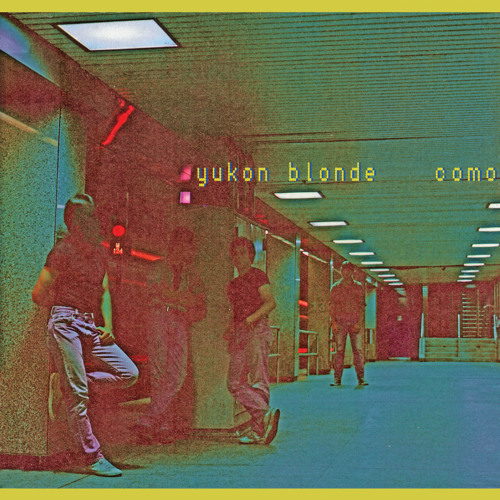
-Music Videos on my Mind- Yukon Blonde’s “Como”

Canadian indie rock group Yukon Blonde have tempered the synth-pop aspect that served them well for the last decade, while boosting the retro indie rock qualities on their new album On Blonde. Their new song Como has the intention of getting alternative indie kids dancing, throwing in 1980s fuzz guitar riffs while building on glossily layered vocals designed to induce feelings of gleeful happiness.
Once again, a music video is missing-in-action, but there’s something very striking about the greenish, grainy still image below. It almost reaches back to a faded and bygone era, though others may argue that it just looks like an underdeveloped photograph taken on a defected disposable camera. Cool song, though.

Monday, 22 June 2015

-Music Videos on my Mind- Leftfield’s “Bilocation”

There was a moment back in the 1990s when Leftfield were described by UK dance and clubbing magazine Mixmag as, “the single most influential production team working in British dance music”.
In 2015, the notion of Leftfield being a ‘production team’ seems slightly disingenuous because the original partnership of Neil Barnes and Paul Daley is no more, with the former having separated from his musical collaborator after many years as a duo.
In fact, Leftfield’s new album Alternative Light Source is the first since 1999, which makes it another one of those revived pieces aimed at capturing the attentions of ageing alternative club culture aficionados, desperate to reconnect with dance music of integrity and purpose, the kind that existed back in the halcyon days of when they were young.
And what a comeback single, as Bilocation tips its hat at all that was bloody marvellous about Leftfield, incorporating a notable guest vocalist in Poliça’s ethereal voiced Channy Leaneagh, creating a  dance track that sounds equally clinical, intimate and stupendously infectious. Just try not to nod your head as the rhythmical beeps and blips take over. Shame no-one bothered commissioning a music video.

Monday, 8 June 2015

Electronic Dance Music is Not Your Friend

Witnessing last month’s trailer for Warner Bros. We Are Your Friends, one can be forgiven for having the utmost cynicism apropos millennials’ attitudes towards dance music.

The high-concept plot could’ve been scribbled on the back of a fag packet: Zac Efron plays a muscle-bound 23-year-old DJ handsomely called Cole, who catches the attention of an established thirtysomething record producer boringly named James (played by Wes Bentley), who wants to mentor the aspiring youth, but things get complicated when the latter’s younger girlfriend dreamily called Sophie (portrayed by Blurred Lines’ model Emily Ratajkowski), falls for the former and his musical ambitions. Routine stuff happens. The end.
One guesses that the aim of this forthcoming release is to cinematically define a culture and sound that seems entirely new to young Americans, but has been commonplace in Europe for the last twenty-five years or so. Due to the fact the trailer lasts over three minutes, demonstrates that perhaps those who’ve made the film are themselves struggling to figure out how exactly dance music has characterised a generation of American youth stifled by a depressed job market and mollycoddled by modern parenting methods which ill-equip them for life in the real world. The actuality that Working Title Films, a British production company behind twee rom-coms, produced this American rave flick, along with French film company StudioCanal, goes to further highlight how potentially clueless and misguided this movie might be.
The notion that in order to become rich and famous one can simply upload a derivative dance track onto their USB stick and fly around the world raking in fortunes, is, frankly, disturbing. Rather than creating a plot concerning creative ambition and graft, We Are Your Friends taps into a scene where expectation and entitlement seem prevalent pillars. The characters showcased in this trailer spend more time discussing the need to get rich through music rather than actually making quality records.

Britain in the ‘90s was a period when dance music was both revolutionary and progressive. The illegal rave parties at the start of that decade were  feared and criminalised by the establishment, yet it was also a scene where young people of different ethnicities and social strata came together to dance and experiment. The close of ‘90s club culture developed big beat groups who took dance music to international heights while still maintaining a cerebral edge so as to ground the tracks in intelligence and integrity. Heck, one still recalls a time when The Prodigy declined an offer to perform on BBC’s flagship Top of the Pops even though it would have boosted their sales hugely. Dance music used to be about credibility and rebellion, whereas it now means absolutely nothing other than mindless partying and moneymaking.
In the light of America’s embrace of dance culture, worryingly, the UK can be argued to be lowering its standards too. Warp Records, that northern powerhouse who is home to electronic music revolutionaries like Aphex Twin and Squarepusher, is busily touting its latest signing Hudson Mohawk.

Hudson Mohawk, a DJ of a similar age to the character Efron plays in this movie, is said to be a master at turntables and sonic smashing, which may explain why Warp signed him. But Mohawk’s latest release Scud Books seems as empty as anything channelled in We Are Your Friends. Dance music should always be about innovation and boundary pushing, not chasing sales. The apparent reality that electronic dance culture has become a benign steppingstone to insignificant infamy and soulless profitability speak volumes about how disposable this scene has become.
Who knows, We Are Your Friends may be this generations Saturday Night Fever, a movie that uses a popular music scene in order to hold a mirror at America’s deeper and darker social issues. Chances are, however, it’ll be as crap as the trailer makes it seem.

Tuesday, 2 June 2015

-Music Videos on my Mind- Ducktails’ “Headbanging in the Mirror”

There’s this irrefutable sound that has been a mainstay of American college radio campus for the last fifty years. This kind of blissed out tune that was instigated by Simon & Garfunkel, perpetuated by the Paisley Underground, perfected by Pavement, and now gets bandied by acts like Real Estate. This is the sound of a young, thinking, educated America, the kind of people that make the US seem comfortingly inspiring.
Ducktails is a sobriquet of one Matt Mondanile, guitarist of aforementioned indie rock band Real Estate. And in all honesty, Headbanging in the Mirror is essentially a Real Estate track in a different name; but one supposes that Mondanile wants to express himself as an original indie pop singer, though, the only way to that is by ditching associations with his day job and becoming something else.

Wednesday, 13 May 2015

Transgender Comedy “Tangerine” Succeeds Because of Talent

American indie filmmaker Sean S. Baker’s new movie Tangerine tells the story of a transgender prostitute called Sin-Dee Rella (Kiki Kitana Rodriguez) who having just been released after serving a month stint in prison for occupational misdemeanours, partners with fellow transgender colleague Alexandra (Mya Taylor) to track down her boyfriend-cum-pimp, Chester (James Ransone). It transpires that Chester has not only been unfaithful but has committed the cardinal sin of cheating on Sin-Dee with a biological female, thus invoking varied elements of thematic, dramatic and comedic gender issues that play  out over the film’s 87 minute running time.
Tangerine’s trailer demonstrates that the movie is high on vérité energy and style, presenting a cinematically charged day-in-the-life dramatisation of Los Angeles’ sex industry, holding at its centre performances of two transgender actors who are both friends in reality and whose familiarity with the  world depicted allowed them to collaborate on the plot. Tangerine is a film cultivating all sorts of praise and attention, meaning that this Sundance breakout hit may become one of summer’s niche surprises.
But perhaps Tangerine’s biggest surprise stems from the fact that the entire thing was shot on three iPhone 5s phones. That’s right, what looks like a professional and slick production was filmed on something many carry around in their back pocket, albeit the camera lens was enhanced with affordable anamorphic adapters that heightened its intimate look while also embellishing it with a widescreen cinematic aspect ratio. It’s a case of accessible technology allowing independent filmmakers to tell their stories without being encumbered by costly crews.
Tangerine has been picked up by Magnolia Pictures who will give the film a proper theatrical roll out in July, with bespoke advertising to boot. A generation ago Tangerine will have been an indie feature shot on cumbersome super 16mm film stock with much bigger cameras, but in today’s age was made by fewer personnel and looks way slicker. However, it seems baffling why there aren’t many more breakthrough indie films of this nature gaining comparable attention when access to digital filmmaking technology has never been better.
Had Tangerine come out in the early ‘90s when the new wave of American independent cinema was all the rage, it probably will have attracted similarly good reviews principally because of its quality. The issue is not with the difficulty of getting films made, but more to do with a lack of original stories and fresh vision framing such narratives. Director Sean S. Baker had the talent and ambition to ensure his movie got made, forcing one to assume that determined personalities such as his will have got their material produced regardless of what era they were realised in.
It can be argued, therefore, that getting films made is not strictly a matter of money, technology or access, but of talent. Woody Allen’s films aren’t especially expensive to produce and get made pretty quickly, which raises the question of why there aren’t more storytellers like him flourishing in this age of filmmaker-friendly conditions?
One supposes the matter may be to do with what kind of movies people want to make and how they want to get them out there. The blurring parameters twixt theatrical exhibition and home cinema viewing are changing in unforeseen ways. It is now reasonably inexpensive to replicate the big screen experience in one’s home, while high definition streaming accessibility means that bona fide moviemakers and film stars are shifting their attention to platforms hitherto viewed as inferior to cinema. As the multiplexes devote attention to cripplingly expensive Hollywood blockbusters and art house cinemas attempt to offset losses by scheduling more screenings of one-off Broadway shows, leftfield and low-budget cinema has had to eschew traditional avenues of presentation in favour of emerging formats. Things are shifting from collectivism and ownership to access and convenience.

The funny thing is that American cinema has changed in unfavourable and depressing ways, especially Hollywood studio productions. Studios have mostly shuttered their indie-skewing divisions as they are no longer economically viable, choosing instead to pick up such films via distribution deals on completion if they’re commercially attractive because of unexpected quality or standout star performances. Big producers such as Brian Grazer (Apollo 13) who had a long time deal with Universal Pictures and Joel Silver (The Matrix) who was expensively housed at Warner Bros. have been tossed out after decades of service, now forced to independently hustle for opportunities in a tough film financing market. They have become surplus to requirement as Hollywood focuses on building in-house franchises rather than hire expensive producers to develop new material that the studio doesn’t have total control over. American cinema isn’t what it was and most likely will never return to what it used to be.
This makes the arrival of Tangerine all the more exciting. Something that was created using the latest everyday technology will be released through traditional and established models of distribution. The truth is that if your project is genuinely worthy and your talents are recognisably brilliant, the films you make will always find their way to audiences.

Thursday, 30 April 2015

-Music Videos on my Mind- Mbongwana Star’s (feat. Konono No.1) “Malukayi”

Listening to Mbongwana Star’s excellent track Malukayi reminds one that perhaps in the future a popular culture sea change will not be the preserve of America or Europe. Cultural trends and changes are happening in the most unlikely of places, and some it is getting a nominal but important degree of attention in primary media markets like Britain. As the economies, educational prosperity and aspirations improve elsewhere and stagnate everywhere else, perhaps there’s reason to think things like pop music in the next thirty years will sound unlike anything we can possibly conceive at present.
The above statement is absolute suspicion, but Malukayi is actually a song that was played on alternative UK radio. That means station programmers deemed it somewhat relevant and accessible enough for inclusion. It’s a small step but perhaps it’s also a significant move. Then again, it may be nothing more than a welcome hipster blip.
Hailing from Congo’s capital city Kinshasa, Mbongwana Star has created a song utilising traditional Congolese chanting and distorted mbria instrumentation, but warping it enough to prove truly leftfield and new-wave, especially in its post-punk guitar work. The track was produced by Parisian sound engineer Doctor L, which makes this proper original fusion music.